
Property management in Colombia
Updated
In Colombia a building with multiple owners is not just a piece of real estate — the moment its reglamento is registered, the law turns it into its own legal entity, separate from every individual owner. That entity, the propiedad horizontal, is the one that holds the funds, signs contracts and sues a non-paying owner, and the administrador is the person who represents it.
Ley 675 de 2001 sets that structure out: what the asamblea decides, what the consejo de administración does where one exists, and what falls to the administrador. It is a single national law, without the state-by-state variation Mexico has.
Here is how the role works in Colombia, why the legal-entity structure changes how collections work, and where the day-to-day operation of a conjunto tends to break down.
The three bodies that run a propiedad horizontal
Ley 675 divides direction and administration three ways, and much of the internal friction comes from not being clear that the council does not manage day to day, and the administrador cannot decide anything the law reserves to the assembly.
| Body | Who it is | What it is responsible for |
|---|---|---|
| Asamblea general de propietarios | Every owner of a private unit | The governing body: appoints and removes the administrador, approves the budget and the fees, elects the consejo de administración where one exists, and approves changes to the reglamento. |
| Consejo de administración | An odd number of owners, elected by the assembly (where the bylaws provide for one) | Makes the decisions needed to run the property between assemblies; it cannot set fees or impose sanctions on its own — that is reserved to the assembly. |
| Administrador | An individual or a company appointed by the assembly (or by the council, where one exists) | The legal representative of the entity: convenes the assembly, collects fees, hires vendors, keeps the books and the minutes, and can start judicial collection of arrears without prior authorisation. |
Why the property itself is a legal entity
This is the point that sets Colombia apart from the rest of the region, and the reason this is not just another row in a vocabulary glossary: as soon as the reglamento is registered, a non-profit civil legal entity is born, separate from each individual owner. It takes the building's name, and its assets are the ordinary and extraordinary fees, fines, interest and the fondo de imprevistos (contingency fund).
In practice this means the administrador does not act personally or on behalf of a loose group of "owners": they act as the legal representative of that entity, and the contracts they sign in that role belong to it, not to them. That is what lets the entity sue a non-paying owner in the building's own name, without every other owner having to be a party to the case.
The entity is also treated as a non-taxpayer for national taxes and for the industria y comercio tax on activity tied to its purpose — managing the shared property and services — which surprises anyone arriving from a market where the building is not a separate taxable party at all.
The consejo de administración: when it is required
A council of administration does not always exist. In residential-use buildings it is optional — the bylaws decide whether to create one. It is mandatory in commercial or mixed-use buildings with more than thirty private units, not counting parking spaces or storage units.
Where it exists, it deliberates and decides with a majority of its members present — unless the bylaws require a higher quorum — and its votes are counted by head, not by co-ownership coefficient the way the assembly's are. What it cannot do, whatever the bylaws might suggest in practice, is take decisions the law reserves to the assembly: setting or raising fees, imposing sanctions the bylaws do not already provide for, or amending the bylaws themselves.
The cuota de administración and the contingency fund
The fee is calculated on each unit's coeficiente de copropiedad — the percentage the deed assigns it of the whole — and splits into the expensa ordinaria, the month's predictable running cost, and the extraordinaria, approved by the assembly for something specific. An extraordinary charge that exceeds four times the monthly necessary expenses over the budget period needs a 70% qualified majority of the coefficients, not the simple majority an ordinary decision takes.
The law also requires a fondo de imprevistos, funded by a surcharge of at least 1% of the annual common-expense budget plus fines and interest. The assembly can suspend that charge once the fund has accumulated half of the year's ordinary budget, and the administrador can only spend from it with the assembly's prior approval.
Arrears: collecting without a declaratory lawsuit first
As anywhere in the region, this is the problem every administrador names first. The Colombian difference is the tool: article 48 of Ley 675 turns the administrador's own debt certificate into a título ejecutivo — an enforceable instrument — with no promissory note, no bill of exchange, no document signed by the owner, and no prior declaratory judgment establishing the debt.
With that certificate the administrador can go straight to a civil judge and file for enforcement, and the law lets them do it on their own initiative, without asking the assembly or the council for authorisation. The right to collect each individual fee lapses five years after it became due, running fee by fee — letting arrears age without acting is what eventually closes that route off.
Before it reaches a courtroom, most of it is resolved the same way it is everywhere: a bill that arrives on time, a reminder before the due date, and somewhere an owner can check their balance without walking down to the front desk.
Meetings: the asamblea
The asamblea ordinaria meets at least once a year, convened by the administrador with at least fifteen calendar days' notice, to approve accounts and the budget. If nobody convenes it, it meets anyway, by operation of law, on the first business day of the fourth month after the budget period ends.
It sits validly with more than half of the coefficients present and decides with half plus one of those represented, except for ten decisions the law reserves to a 70% qualified majority of the building's entire coefficients — among them amending the bylaws, releasing a common asset from that status, or dissolving the property. No decision, other than winding up the propiedad horizontal itself, can require more than 70%: a bylaw that sets a higher bar is treated as if it were never written.
Decisions taken under the law and the bylaws bind every owner, including those who were absent or voted against. That is what makes a badly convened assembly so costly: an irregular notice voids everything it approved.
Why communication eats the week
Ask an administrador in Bogotá, Medellín or Cali where the week goes and the answer is rarely the report to the council. It is the chat.
The pattern repeats building by building: one WhatsApp group per tower carrying the management's notice, a noise complaint and the same question — what do I owe, when is the elevator technician coming, what do the bylaws say about pets — asked again by a different owner. The request that actually needed a council decision sits three screens up.
The cost is not only the administrador's time. It is that the building keeps no record of anything. When the administración changes, that history does not carry over, and the council starts asking everything from scratch.
One group
Everything, for everyone
- 5B
Has anyone seen an orange cat? - Management
Water is off tomorrow, 9am to 1pm. - 3A
The gate has been broken for three days. - 7C
What about this month's fees? - 2D
🙏
One thread per resident
Private, with status
3A · Gate
Vendor notified
7C · Fees
Answered
5B · Move-in
Needs your decision
Where Eloria fits
Eloria handles that part and not the others: it does not replace the entity's accounting or the management software the administración already uses.
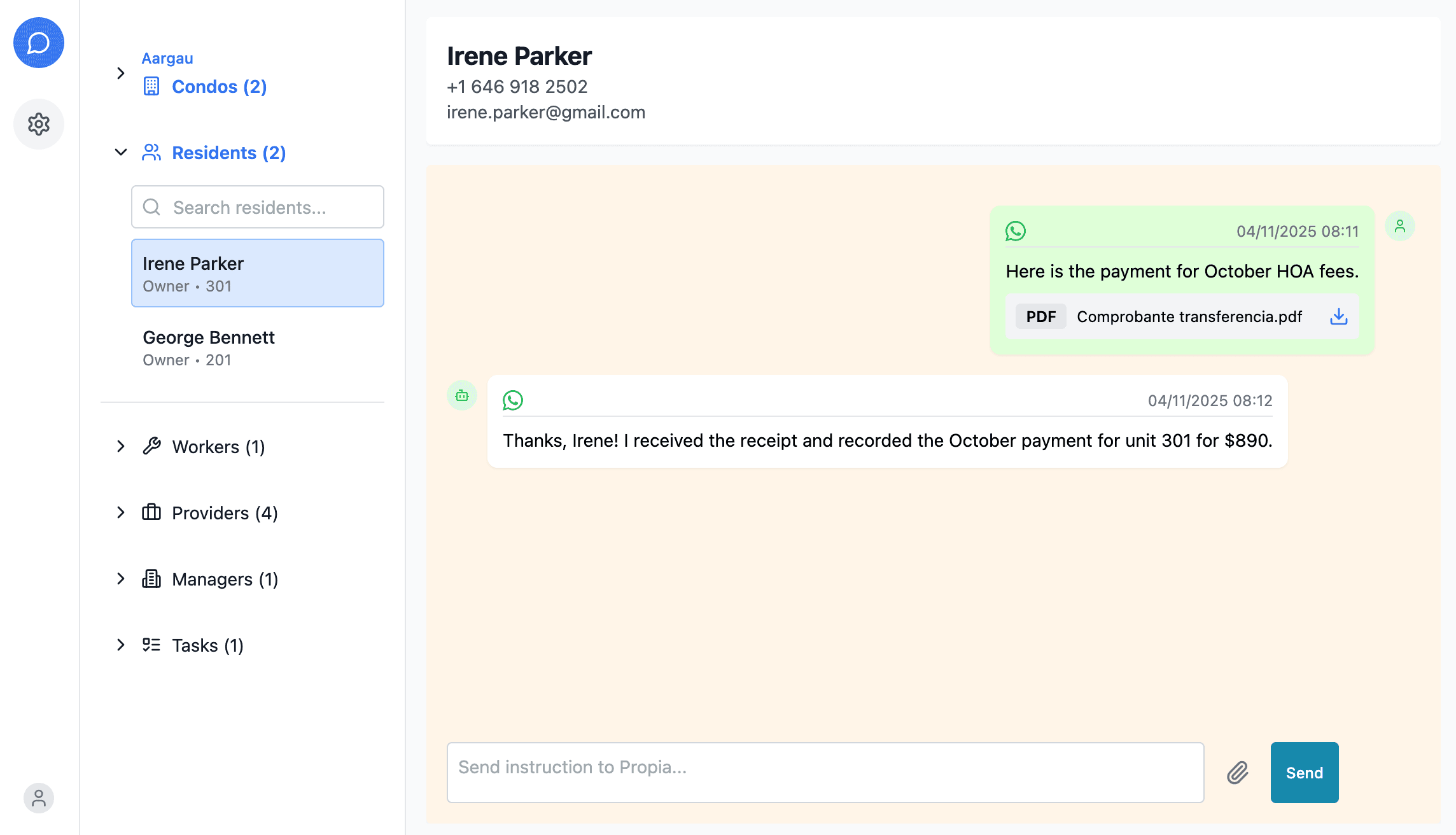
Owners write on WhatsApp, where they already are. Eloria answers from the building's own information — the reglamento de propiedad horizontal, common-area hours, current notices — opens a case when a vendor or a council decision is needed, and escalates it. Everything is recorded per unit and per case, so the history survives a change of administrador.
It speaks the building's own vocabulary — propiedad horizontal, copropietarios, cuota de administración, cartera — rather than a translation of what another market calls the same thing.
Managing propiedad horizontal in Colombia and want to see it running on a real building? Message us on WhatsApp and we will set it up with your data.
Message us on WhatsAppKeep reading
- Building management in Chile
How a Chilean building (condominio) is run under Ley 21.442: what the asamblea de copropietarios decides, what the comité de administración and the administrador do, how gastos comunes are billed, and why administrators must now be registered.
- Condo management in Mexico
How a Mexican condominio is actually run: what the asamblea decides, what the administrador and comité de vigilancia do, how the cuota de mantenimiento is calculated, and what an owner should check.
- Property management software: what to look for before you choose
A practical guide for condo and building managers: what property management software actually solves, what to ask in the demo, and why resident communication is usually the piece left out.
- The building's WhatsApp group: why it gets out of hand and what to do
Why the building WhatsApp group becomes ungovernable, what the usual alternatives are and why they fail, and how to bring order to resident communication without taking away the channel they already use.
- Expensas, gastos comunes, cuota de administración: one fee, many names
What the monthly owners' fee is called in each Latin American market — expensas, gastos comunes, cuota de administración, cuota de mantenimiento — and what differs beyond the name.