
Guide to Condo Management in Mexico
Updated
If you own a unit in a Mexican condominio — in Cancún, Playa del Carmen, Mexico City, Puerto Vallarta — the person you deal with month to month is the administrador. What they can and cannot do is set by three documents, and none of them is a federal law.
Mexico regulates propiedad en condominio state by state: Mexico City, Jalisco, Nuevo León and Quintana Roo each have their own statute. Above the state law sit the building's escritura constitutiva, the deed that created the condominio and fixed each unit's share of it, and its reglamento interno.
Here is what the structure looks like in practice, named in the words it is actually named in — which is worth knowing before you sit in your first asamblea.
The three bodies that run a condominio
Almost every state statute divides authority the same way. Knowing the split answers most of the questions an owner arriving from another market has, starting with why the administrador keeps saying a decision is not theirs to make.
| Body | Who it is | What it is responsible for |
|---|---|---|
| Asamblea general | All the condóminos (owners) | The highest authority: approves the budget and the fees, reviews the accounts, appoints or removes the administrador, authorises works and changes to the bylaws. |
| Administrador | An individual or a company, an owner or an outside firm | Executes what the asamblea approved: collects fees, maintains common areas, hires and supervises vendors, keeps the books and reports back. |
| Comité de vigilancia | Owners elected at the asamblea | Oversees the administrador and checks that spending matches what was approved. It does not manage or contract. |
What your cuota de mantenimiento pays for
Each owner's monthly fee is normally calculated on their indiviso — the participation percentage the escritura constitutiva assigns to the unit, usually tied to floor area. Owners in the same building pay different amounts, by design, and it surprises nearly every first-time buyer.
The cuota ordinaria covers the month's running costs: security, cleaning, water, common-area electricity, elevators, landscaping. A cuota extraordinaria is approved by the asamblea for a specific project and apportioned separately. Many condominios also hold a fondo de reserva, which is what keeps every elevator failure from becoming an extraordinary assessment.
Arrears are the single most cited problem, and what the condominio can do about them varies by state. It is worth asking how the building handles collections before you assume a healthy budget: a condominio whose reported fee looks low may simply be one where a third of the units are not paying.
Meetings: the asamblea
The asamblea ordinaria is the annual meeting that approves the year's accounts and the next budget, and confirms or replaces the administrador. An asamblea extraordinaria is called for anything that cannot wait: a major work, a change to the reglamento interno, removing the administrador.
Notice periods, quorum and voting rules come from the state statute and the building's own bylaws, and they differ enough between states that no general rule is useful — the local law has to be read. What is common everywhere is the consequence of getting it wrong: a badly convened asamblea can be challenged, and so can everything it approved.
Absentee owners are the structural difficulty here. A building where a large share of units are second homes or rentals held from abroad struggles to reach quorum at all, which is why powers of attorney and proxy voting matter more in Mexican coastal condominios than almost anywhere else in the region.
What to check before you buy
The condominio's own paperwork tells you more about the next five years of ownership than the unit does. Four things are worth asking for by name.
- The minutes of the last asamblea and the administrador's most recent account. If neither exists, that is the finding.
- Whether the unit carries arrears. In several states the debt attaches to the unit rather than the seller, so it can follow the property to you.
- The reglamento interno's rules on short-term rentals. This is the most common surprise for investment buyers in Quintana Roo and Baja California Sur, where a building can prohibit exactly the use the purchase was built around.
- Whether there is a fondo de reserva and what is in it. A condominio without one funds every repair by extraordinary assessment, which is a cost you cannot forecast.
Why communication is the hard part
Ask a Mexican administrador where the week goes and the answer is rarely the accounting. It is the phone.
The pattern repeats building by building: a WhatsApp group per tower where notices, complaints and unrelated conversation share one thread; direct messages at any hour; the same question — what do I owe, when does the pool service come, where are the bylaws — asked again by different people; and somewhere in there, the request that mattered, three screens up.
For an owner abroad the same problem shows up as silence. You are in another time zone, possibly asking in another language, and there is no record of what you asked or whether it was resolved. When the administrador changes, that history does not exist at all.
One group
Everything, for everyone
- 5B
Has anyone seen an orange cat? - Management
Water is off tomorrow, 9am to 1pm. - 3A
The gate has been broken for three days. - 7C
What about this month's fees? - 2D
🙏
One thread per resident
Private, with status
3A · Gate
Vendor notified
7C · Fees
Answered
5B · Move-in
Needs your decision
Where Eloria fits
Eloria handles that part and not the others: it is not an accounting system and does not try to replace one.
Residents and owners write on WhatsApp, where they already are and where there is nothing to install. Eloria answers from the condominio's own information — the reglamento interno, common-area hours, current notices — opens a case when a vendor or a decision is needed, and escalates it to the administrador. Everything is recorded per unit and per case, so the history survives a change of administrador.
It speaks each market's vocabulary rather than a translation: cuota de mantenimiento and condóminos in Mexico, expensas in Buenos Aires, gastos comunes in Santiago.
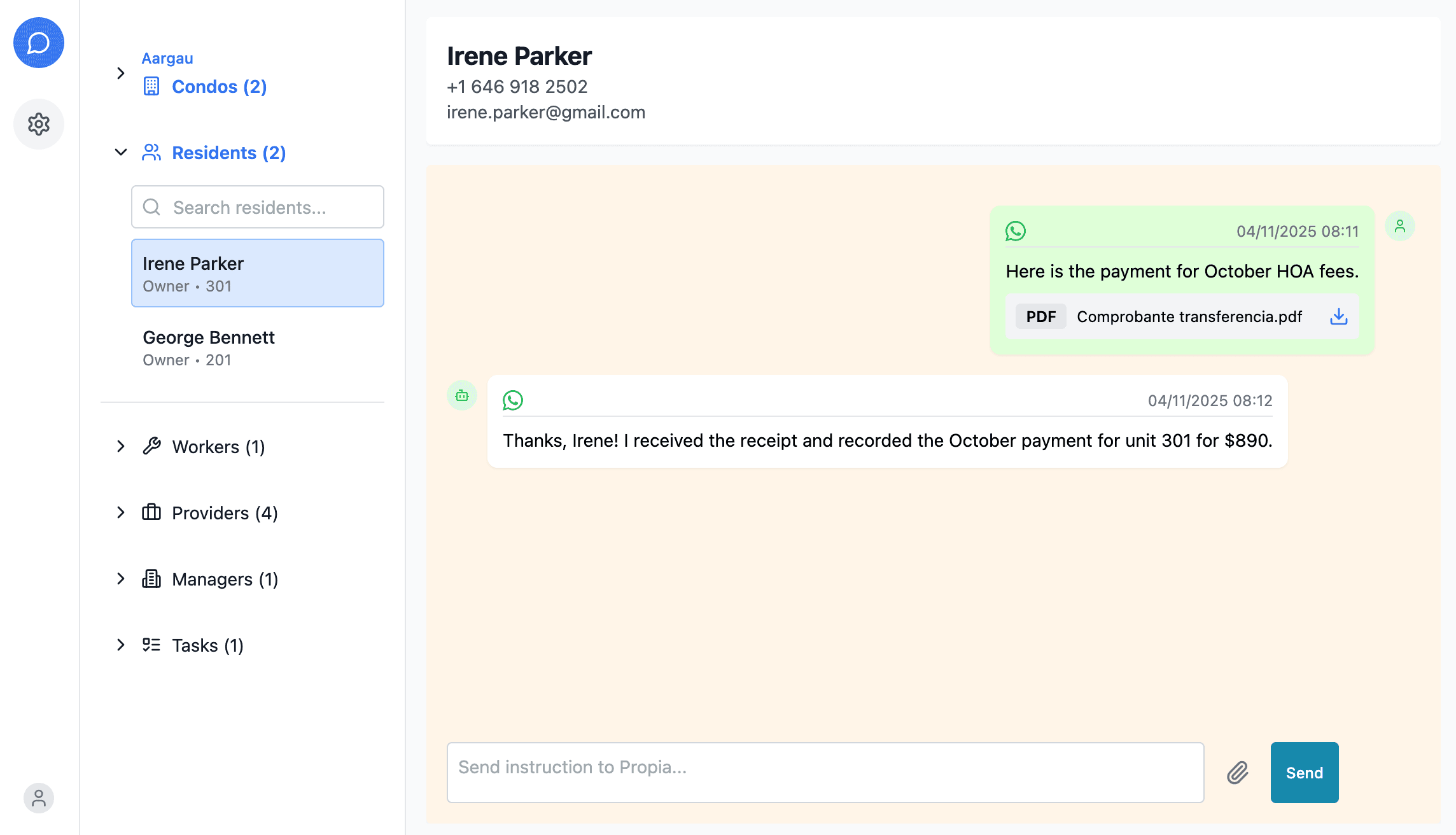
Managing or investing in condominios in Mexico and want to see it running on a real building? Message us on WhatsApp and we will set it up with your data.
Message us on WhatsAppKeep reading
- Building management in Peru
How a Peruvian building or condominio is run: what the junta de propietarios decides, what the administrador does, how cuotas de mantenimiento are billed, and what the practical challenges are.
- Condo Management in Argentina Guide
Complete guide to Argentine consorcio management: asamblea, administrador and consejo de propietarios roles, expensas billing, and arrears collection under current law.
- Property management in Colombia
How a Colombian conjunto or edificio is run under Ley 675 de 2001: why the property itself is a legal entity, what the asamblea, the consejo de administración and the administrador each do, how the cuota de administración is billed, and how arrears are collected.
- Guide to Building Management in Chile
Everything about building management in Chile under Ley 21.442: gastos comunes, assemblies, national administrator registry, and how to organize communication with owners.
- Property management software: what to look for before you choose
A practical guide for condo and building managers: what property management software actually solves, what to ask in the demo, and why resident communication is usually the piece left out.
- The building's WhatsApp group: why it gets out of hand and what to do
Why the building WhatsApp group becomes ungovernable, what the usual alternatives are and why they fail, and how to bring order to resident communication without taking away the channel they already use.
- Expensas, gastos comunes, cuota de administración: one fee, many names
What the monthly owners' fee is called in each Latin American market — expensas, gastos comunes, cuota de administración, cuota de mantenimiento — and what differs beyond the name.