
Guide to Building Management in Chile
Updated
If you own a unit in a Chilean building — in Santiago, Viña del Mar, Concepción — a single national law governs how it is run, unlike Mexico, where each state has its own statute. Since April 2022 that law is N° 21.442, which replaced the older Ley 19.537 after 24 years without a structural update.
The change was not cosmetic. It professionalised the administrator's role, sorted assemblies and expenses into clearer categories, and gave the community a collections tool it did not have before — on top of the structure every building already had: an assembly that decides, a committee that represents it, and an administrator who executes.
Here is how the role works today, what Ley 21.442 changed, and what an owner should check before relying on any of it.
The three bodies that run a Chilean building
Ley 21.442 divides authority three ways, and the relationship between them is the most common source of friction when it is not understood: the committee does not manage the building day to day, and the administrator cannot decide on its own anything the assembly has not delegated to it.
| Body | Who it is | What it is responsible for |
|---|---|---|
| Asamblea de copropietarios | Every unit owner | The highest authority: approves the budget, sets extraordinary charges, appoints or removes the committee and the administrator, and approves the co-ownership bylaws. |
| Comité de administración | 3 to 5 owners, elected for 3 years | Represents the assembly day to day: hires or removes the administrator, oversees budget execution, and authorises urgent repairs or improvements. |
| Administrador | An individual or a company registered with the state | Executes what was approved: collects the gastos comunes, maintains the common areas, hires vendors, keeps the books, and reports to the committee monthly and to the assembly yearly. |
Administrators must now be on a national registry
This is the one change under Ley 21.442 with no real equivalent elsewhere in the region: every administrator, individual or company, must be listed on the Registro Nacional de Administradores de Condominios kept by the Ministry of Housing (MINVU). Before 2022, anyone could take the role with no registration at all.
For a buyer or a board this changes the question worth asking before signing: verifying an active registration now matters as much as checking references. It is also a real filter on incompetent or unaccountable operators — one a building choosing its first professional administrator may not know to ask about.
A registered administrator's powers were also expanded: applying penalties set in the bylaws, suspending non-essential common-area services for owners three or more payments behind, and pursuing unpaid fees through the courts.
What gastos comunes cover, and the reserve fund
The law splits gastos comunes ordinarios — the month's predictable running costs: doorman, cleaning, common-area electricity, elevators, scheduled maintenance — from gastos comunes extraordinarios, approved by the assembly for something specific and non-recurring, like a major project or an unplanned repair.
Every building must also hold a fondo común de reserva, funded by a fixed share of the ordinary fee plus fines and interest. Its use is legally restricted to repairs and improvements to common property — it cannot be used to cover a shortfall in the month's running costs.
The administrator must prepare a budget for the next twelve months and send it to the committee and every owner at least thirty days ahead, stating whether the reserve fund is expected to be used or whether the ordinary fee needs a surcharge.
Arrears, and the notice that doubles as a court filing
Arrears are, as everywhere in the region, the single most cited problem. What is different in Chile is the legal tool: since Ley 21.442, the monthly gastos comunes notice, signed by the administrator, carries the legal weight of a título ejecutivo. That lets the building file directly for expedited debt collection without first winning a separate declaratory judgment, considerably shortening the legal path against a non-paying owner.
Before reaching that point, most arrears are resolved the same way they are anywhere: a bill that arrives on time, a reminder before the due date, and a place an owner can check their balance without walking down to the front desk to ask.
Meetings: ordinary, extraordinary, and now virtual
The law distinguishes three kinds of assembly by what is being voted on: the asamblea ordinaria, held at least once a year to approve accounts and the budget; the extraordinaria de mayoría absoluta, for intermediate decisions; and the extraordinaria de mayoría reforzada, reserved for structural matters like amending the bylaws or authorising major works.
Ley 21.442 also allows an assembly to be held in person, virtually, or as a hybrid, and lets the community adopt resolutions by written consultation or electronic means without physically convening — a change aimed at buildings where reaching in-person quorum is itself the obstacle.
As anywhere, an assembly convened incorrectly, or held with the wrong quorum for the type of decision on the table, can be challenged, and so can everything it approved. The required quorum depends on the type of assembly and each building's own bylaws, so no single number applies to every building.
Why communication eats the week
Ask a Chilean administrador where the week goes and the answer is rarely the monthly report to the committee. It is the front-desk chat.
The pattern repeats tower by tower: one WhatsApp group per building carrying the water-outage notice, a noise complaint and the same recurring question — what do I owe, when is the plumber coming, what do the bylaws say about pets — asked by a different owner each time. The request that actually needed a committee decision sits three screens up.
The cost is not only the administrator's time. It is that the building keeps no record of anything. When the administradora changes, that history does not transfer, and the committee starts asking everything over again.
One group
Everything, for everyone
- 5B
Has anyone seen an orange cat? - Management
Water is off tomorrow, 9am to 1pm. - 3A
The gate has been broken for three days. - 7C
What about this month's fees? - 2D
🙏
One thread per resident
Private, with status
3A · Gate
Vendor notified
7C · Fees
Answered
5B · Move-in
Needs your decision
Where Eloria fits
Eloria handles that part and not the others: it does not replace the accounting or the management software an administradora already uses.
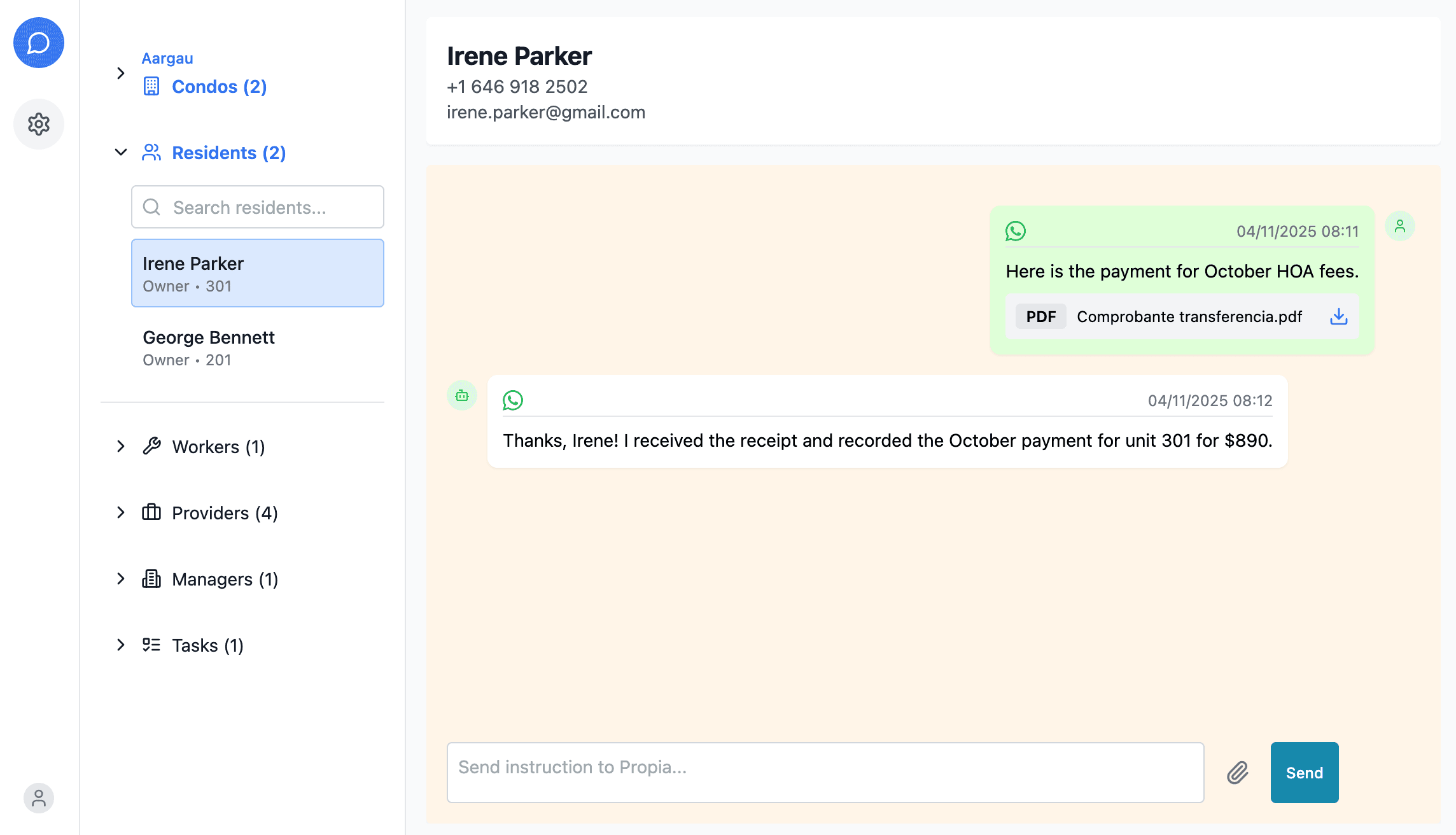
Owners write on WhatsApp, where they already are. Eloria answers from the building's own information — the reglamento de copropiedad, common-area hours, current notices — opens a case when a vendor or a committee decision is needed, and escalates it. Everything is recorded per unit and per case, so the history survives a change of administrator.
It speaks the building's own vocabulary — gastos comunes, copropietarios, comité de administración — rather than a translation of what another market calls the same thing.
Managing buildings in Chile and want to see it running on a real community? Message us on WhatsApp and we will set it up with your data.
Message us on WhatsAppKeep reading
- Building management in Peru
How a Peruvian building or condominio is run: what the junta de propietarios decides, what the administrador does, how cuotas de mantenimiento are billed, and what the practical challenges are.
- Condo Management in Argentina Guide
Complete guide to Argentine consorcio management: asamblea, administrador and consejo de propietarios roles, expensas billing, and arrears collection under current law.
- Property management in Colombia
How a Colombian conjunto or edificio is run under Ley 675 de 2001: why the property itself is a legal entity, what the asamblea, the consejo de administración and the administrador each do, how the cuota de administración is billed, and how arrears are collected.
- Guide to Condo Management in Mexico
Learn how to manage condominios in Mexico: legal structure, cuotas de mantenimiento, asambleas, and how to keep records of everything happening in your building. Updated 2026.
- Property management software: what to look for before you choose
A practical guide for condo and building managers: what property management software actually solves, what to ask in the demo, and why resident communication is usually the piece left out.
- The building's WhatsApp group: why it gets out of hand and what to do
Why the building WhatsApp group becomes ungovernable, what the usual alternatives are and why they fail, and how to bring order to resident communication without taking away the channel they already use.
- Expensas, gastos comunes, cuota de administración: one fee, many names
What the monthly owners' fee is called in each Latin American market — expensas, gastos comunes, cuota de administración, cuota de mantenimiento — and what differs beyond the name.