
Condo management in Argentina
Updated
In Argentina a building under the propiedad horizontal regime is not just real estate divided into units — once its reglamento is registered, it becomes a consorcio de propietarios, with its own governing bodies and a separate patrimony. Ley 13.512, in force since 1948 and complemented by the Código Civil y Comercial, sets that structure out.
What the law calls a consorcio is what Chile calls an edificio or comunidad and Mexico calls a condominio. The administrador de consorcios is the person who runs the day to day: collects the expensas, hires vendors, reports to the asamblea and the consejo de propietarios, and is usually also the one who answers every message, every question and every complaint from the consorcistas.
Here is how the role works in Argentina, what the Código Civil y Comercial changed in 2015, and where the day-to-day operation of a consorcio in Buenos Aires, Córdoba or Rosario tends to break down.
The three levels of decision in a consorcio
The law divides authority three ways, and most internal conflicts come from not understanding that the council does not manage and the administrador cannot decide alone anything the assembly has not expressly delegated.
| Body | Who it is | What it is responsible for |
|---|---|---|
| Asamblea de propietarios | All the co-owners in the building | The governing body: approves the budget and the expensas, appoints or removes the administrador, elects the consejo de propietarios, authorises works and changes to the reglamento. |
| Consejo de propietarios | 1 to 5 owners, elected at the assembly depending on the size of the building | Oversees the administrador's management, audits the accounting and the reports, and convenes the assembly when the administrador does not or when the council considers it necessary. |
| Administrador | An individual or a company appointed by the assembly (an owner or an outside professional) | Executes what was decided: collects expensas, pays vendors, contracts services, keeps the books, convenes the annual ordinary assembly, and represents the consorcio in collection lawsuits and in dealings with third parties. |
The consejo de propietarios: mandatory since when
The Código Civil y Comercial of 2015 made the consejo de propietarios mandatory, where before it was optional and almost nobody formed one. Since then every consorcio must have one, with at least one owner in buildings of up to ten units, and at least three in larger ones.
The council does not manage: it audits. Its job is to oversee the administrador, review the books, approve or reject each account before it reaches the assembly, and be available to any owner who wants to consult the consorcio's documentation. It is also the body that convenes the assembly if the administrador does not, and the one that can file a lawsuit to remove the administrador if there are serious irregularities.
In practice many consorcios have a council on paper but not in reality: names that appear in the minutes but never review anything. That is fine until a problem appears and everyone discovers nobody was watching.
Professional administrador or an owner who manages
The consorcio can elect one of its owners as administrador or hire a professional. The decision is usually made looking only at cost, which is the easiest parameter to compare.
Unpaid management by an owner works while the building is small, the neighbor who accepted has availability, and the rest respect their time. It breaks down almost always in the same place: the person cannot sustain the administrative load and the attention at the same time, and when they resign they take with them everything they knew, because nothing was recorded anywhere.
The professional administrador charges fees — typically a percentage of the ordinary expensas or a fixed amount per unit — and brings method: tidy reports, organised files, vendors with track records. What it does not always solve is availability: an administrador with twenty buildings receives queries from twenty buildings, and that is where response time becomes the most cited problem, even when the accounts are impeccable.
Three questions worth asking before hiring:
- How many consorcios do you currently manage and how many units in total? The answer says whether the administrador has capacity to attend or is already saturated.
- How and when are reports delivered, and with what supporting documentation? A report that arrives late or without receipts is the first sign of disorder.
- What happens to the books, minutes and contracts if the contract ends? A handover without documentation leaves the consorcio starting from zero, and that should not be legal but it happens.
Ordinary expensas, extraordinary, and the reserve fund
The expensas ordinarias cover the month's running costs: doorman, cleaning, common-area electricity, elevators, scheduled maintenance, insurance, administrador fees. They are calculated on each functional unit's percentage, which appears in the reglamento de copropiedad and is usually tied to floor area, though not always in a strictly proportional way.
Expensas extraordinarias are approved by the assembly for specific, non-recurring expenses: a project, a major repair, an unexpected cost not covered by the reserve fund. They are apportioned separately and do not form part of the annual ordinary budget.
The fondo de reserva is what keeps every breakdown from becoming an extraordinary charge. The law does not set a minimum percentage, but practice suggests at least 5% of ordinary expensas, and the assembly can decide a higher amount. The administrador manages that fund, but it can only be used for repairs and improvements that the assembly or the reglamento authorise, not to cover a management deficit.
Arrears and judicial collection of expensas
Arrears on expensas are the problem every Argentine administrador names as the most frequent and most draining. The collection tool is the juicio ejecutivo — expedited enforcement: the debt certificate issued by the consorcio's administrador has executory force, which allows filing directly without first winning an ordinary lawsuit recognising the debt. That does not mean the process is fast — Civil Justice in Capital Federal and the provinces can take years — but it is at least the most direct route.
The right to collect each expensa lapses two years from its due date. Letting that deadline pass without acting is what makes uncollectable a debt that was enforceable, and it is one of the most common complaints current-paying owners make to the administrador when they learn the consorcio lost the ability to collect.
Before reaching the courts almost all the margin is in the operation: an account statement that arrives the same day each month, a reminder before the due date, and somewhere the owner can check their balance without having to call the administrador or stop by the front desk. Much of the arrears is not bad faith, it is disorganisation.
Meetings: ordinary, extraordinary and second call
The asamblea ordinaria must meet at least once a year, within the first four months of the fiscal period, to approve the previous period's account and the next budget. Notice must be given at least ten days in advance, stating place, date, time and agenda. If there is no quorum at the first call — a majority of owners present — it moves to a second call half an hour later, and there the assembly sits validly with whatever owners are present, with no minimum.
Decisions are adopted by majority of those present, computed by each unit's percentage, except for amendments to the reglamento de copropiedad and works that constitute an innovation or a structural modification, which require two thirds of those present at first call or an absolute majority of owners at second call.
A badly convened assembly, without the required advance notice or without including in the notice a topic that was then voted on, can be challenged in court, and with it fall all the decisions it adopted. That is why care in the convocation and the minutes is not formalism: it is what gives validity to what is resolved.
Why communication eats the week
Ask an administrador de consorcios in Buenos Aires, Córdoba or Rosario where the week goes and they almost never say «the reports». They say the phone.
The pattern repeats building by building: one WhatsApp group per consorcio where the administrador's announcement, a complaint about leaks, and the same question — what do I owe, when is the plumber coming, what do the bylaws say about pets — asked again by different owners all coexist, and somewhere in there the request that actually needed assembly approval, buried three screens up.
The cost is not only the administrador's time. It is that the consorcio keeps no record of anything. When the administrador changes, that history does not exist: what was requested, who requested it, whether it was resolved. And whoever arrives starts from zero, asking everything again.
One group
Everything, for everyone
- 5B
Has anyone seen an orange cat? - Management
Water is off tomorrow, 9am to 1pm. - 3A
The gate has been broken for three days. - 7C
What about this month's fees? - 2D
🙏
One thread per resident
Private, with status
3A · Gate
Vendor notified
7C · Fees
Answered
5B · Move-in
Needs your decision
Where Eloria fits
Eloria handles that part and not the others: it is not an accounting system and does not replace your management software.
Owners write on WhatsApp, where they already are. Eloria answers from the consorcio's information — the reglamento de copropiedad, common-area hours, current notices — opens a case when a vendor or a council or assembly decision is needed, and escalates it to you. Everything is recorded per unit and per case, so the history survives a change of administrador.
It speaks the consorcio's vocabulary: expensas, propietarios, consejo de propietarios, encargado. Not a translation of what is said in Chile or Mexico.
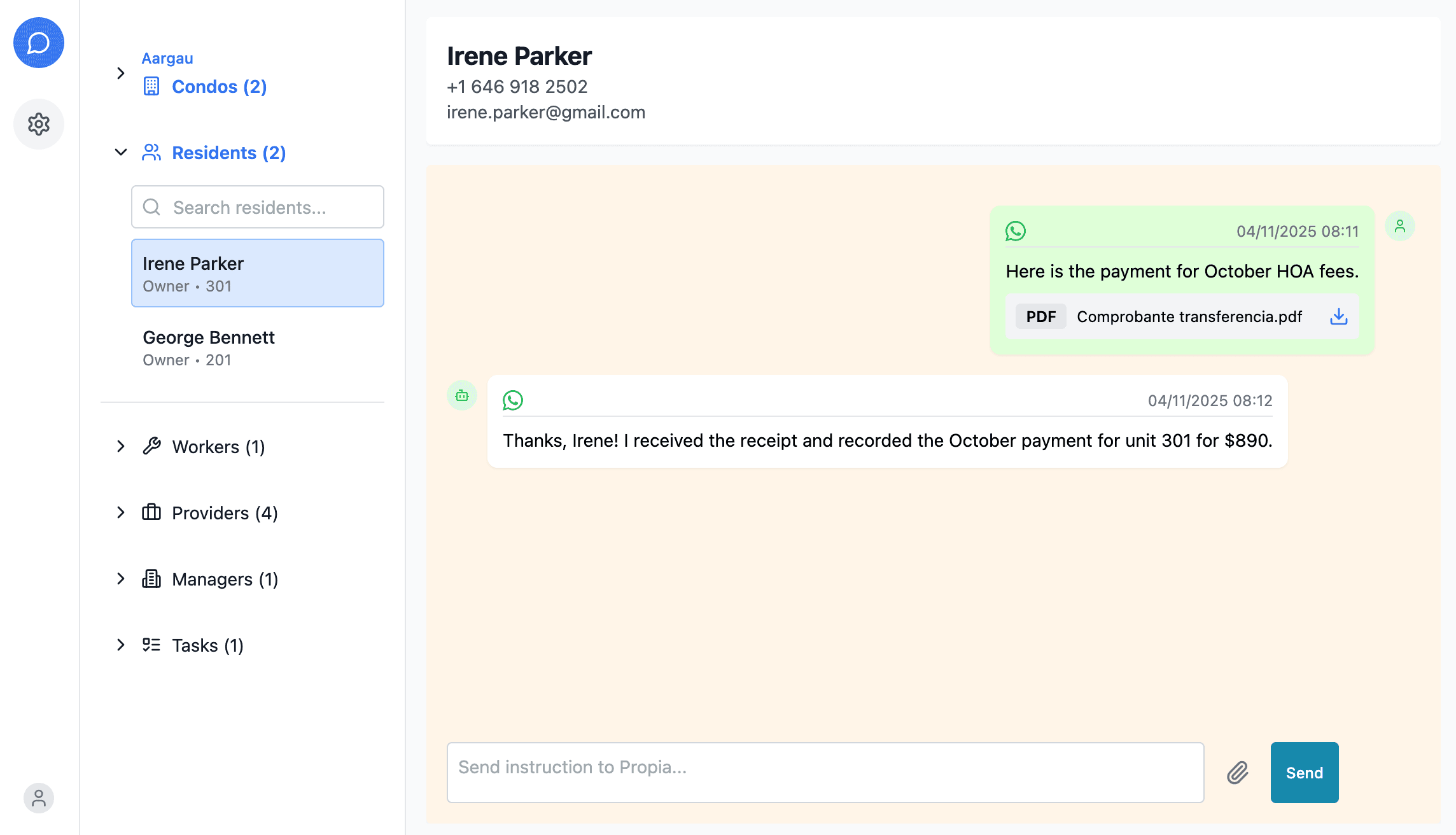
Managing consorcios in Argentina or Uruguay and want to see it running on a real building? Message us on WhatsApp and we will set it up with your data.
Message us on WhatsAppKeep reading
- Property management in Colombia
How a Colombian conjunto or edificio is run under Ley 675 de 2001: why the property itself is a legal entity, what the asamblea, the consejo de administración and the administrador each do, how the cuota de administración is billed, and how arrears are collected.
- Building management in Chile
How a Chilean building (condominio) is run under Ley 21.442: what the asamblea de copropietarios decides, what the comité de administración and the administrador do, how gastos comunes are billed, and why administrators must now be registered.
- Condo management in Mexico
How a Mexican condominio is actually run: what the asamblea decides, what the administrador and comité de vigilancia do, how the cuota de mantenimiento is calculated, and what an owner should check.
- Property management software: what to look for before you choose
A practical guide for condo and building managers: what property management software actually solves, what to ask in the demo, and why resident communication is usually the piece left out.
- The building's WhatsApp group: why it gets out of hand and what to do
Why the building WhatsApp group becomes ungovernable, what the usual alternatives are and why they fail, and how to bring order to resident communication without taking away the channel they already use.
- Expensas, gastos comunes, cuota de administración: one fee, many names
What the monthly owners' fee is called in each Latin American market — expensas, gastos comunes, cuota de administración, cuota de mantenimiento — and what differs beyond the name.