
Building management in Peru
Updated
If you own a unit in a Peruvian building — in Lima, Arequipa, Trujillo — the legal framework comes from Ley N° 27157 and the regulations on exclusive and common property. Unlike Chile, where Ley 21.442 professionalised the administrator's role with a national registry, or Colombia, where the building becomes a legal person once its bylaws are registered, Peru's framework is more flexible and less prescriptive.
What does repeat across most buildings is the structure: a junta de propietarios that decides, an administrador who executes, and an internal reglamento that fills in what the national law leaves open. In practice, professional external administration is still less common outside Lima's newer districts — Miraflores, San Isidro, Surco — and in many older buildings the administration is handled by an owner with no specific training.
Here is how the role works in Peru, what the administrator should do, how cuotas de mantenimiento are organised, and where the operation tends to break down.
How authority is divided in a Peruvian building
National law sets the general framework, but each building's internal reglamento carries more weight than it would in Colombia or Chile. Understanding the division answers most questions and avoids the most common misunderstanding: that the administrator can authorise on their own something the junta has not delegated.
| Body | Who it is | What it is responsible for |
|---|---|---|
| Junta de propietarios | All the unit owners | The decision body: approves the budget and the fees, elects or removes the administrator, authorises major works, and approves or amends the internal reglamento. |
| Administrador | An individual or company appointed by the junta (an owner or an outside firm) | Executes what the junta approved: collects cuotas de mantenimiento, hires and supervises vendors, maintains common areas, keeps the books, and reports to the junta. |
| Committee or vigilance council | Owners appointed by the junta (when the reglamento provides for it) | Oversees the administrator and reviews accounts before the junta. Not legally required and many buildings do not have one. |
Internal administration or a professional firm
A building can appoint one of its own owners as administrator or hire a professional management firm. It is the most structural decision a junta makes, and it is almost always made by looking only at the immediate cost, which is the easiest thing to compare.
Internal administration by an owner is the most common form in older buildings, in provinces, and in Lima districts outside the financial zone. It costs less in cash and works while the building is small and the neighbor who accepted the role has time available. The problem appears when that person can no longer or no longer wants to continue: everything they knew — which vendors work well, which units owe, what repairs were made and why — leaves with them, because nothing was documented.
Professional administration costs more and brings method: monthly reports, vendors with track records, orderly accounting that the committee can review. What it does not always solve is availability: if a management firm handles fifteen or twenty buildings, response time can be slow even if the accounts are up to date. And if the building does not have a clear service contract, it may end up paying for an administrator who only appears on collection day.
Before hiring, it is worth asking:
- How many buildings do you currently manage and how many units in total? The answer says whether they have capacity to attend or are already overloaded.
- How are monthly reports delivered, with what supporting documentation and on what schedule? A report that arrives late or without receipts is a sign of disorder.
- What happens to the documentation — books, minutes, active contracts — if the contract ends? A handover without files leaves the building starting from zero.
The cuota de mantenimiento and the reserve fund
Each owner's monthly fee is normally calculated on their participation percentage in the building, set in the property deed and usually tied to the unit's floor area. It is not an equal amount for everyone, and that difference surprises anyone buying their first apartment who compares their bill with the neighbor's.
The cuota ordinaria — the month's predictable running costs: security, cleaning, water, common-area electricity, elevators, landscaping — is distinguished from the cuota extraordinaria, which the junta approves for something specific: a major repair, a project, a cost not foreseen in the annual budget.
Many buildings also hold a reserve fund, though the law does not set a mandatory minimum percentage as in Colombia or Chile. That fund is what keeps every elevator breakdown from becoming an emergency extraordinary charge. In practice, buildings without a reserve fund live from crisis to crisis.
Arrears and the executive collection process
Arrears are the problem every Peruvian administrator names most. Ley 27157 and its regulations allow the junta de propietarios, represented by its president and with the required supporting documents, to initiate an executive/enforcement process to collect unpaid ordinary and extraordinary assessments, without first needing a declaratory action. It is a tool similar to Colombia's título ejecutivo or Chile's debt certificate, though less well known and less used in practice.
The challenge is not so much the lack of legal recourse but the cost and time even an executive process consumes in the courts. Many buildings do not take legal action until the accumulated debt justifies the effort, and by that point the defaulter already owes several years of fees.
Before reaching the courts almost all the margin is in operations: a clear account statement that arrives the same day each month, a reminder before the due date, and somewhere the owner can check what they owe without having to go down to the front desk to ask. Much of the arrears is not refusal to pay, it is disorder or lack of follow-up.
The junta de propietarios
The junta ordinaria is the annual meeting where the previous year's accounts and the next budget are approved, and where the administrator is confirmed or changed. The junta extraordinaria is convened for decisions that cannot wait: a major work, a change to the internal reglamento, removal of the administrator for serious cause.
Notice requirements, quorum and voting rules are set by each building's internal reglamento more than by national law, and they vary enough from one property to another that no general rule is useful. What is common to all is the consequence of getting it wrong: a badly convened junta, without the advance notice the reglamento requires or with insufficient quorum for the decision that was voted on, can be challenged, and with it everything it approved.
In practice, reaching quorum is the biggest obstacle. Many owners do not live in the building — they rent it out or keep it closed — and do not attend. Others do not get involved until there is a serious problem. That makes convocation and attendance confirmation an essential part of the administrator's work in the weeks before the junta.
Why communication eats the week
Ask a Peruvian administrator where the week goes and they rarely say «the account reports». They say the owners' chat.
The pattern repeats building by building: one WhatsApp group per tower where the water-outage notice, the noise complaint, the question about the reglamento, and the same recurring question — what do I owe, when is the technician coming, what time does the pool work — asked again by different people all coexist. The request that actually needed a junta decision is buried two screens up.
The cost is not only the administrator's time: it is that the building keeps no record of anything. What was requested, who requested it, whether it was resolved. When the administrator changes — because they resigned, because the junta removed them, or because they simply got tired — that history does not transfer, and whoever arrives starts asking everything again from zero.
One group
Everything, for everyone
- 5B
Has anyone seen an orange cat? - Management
Water is off tomorrow, 9am to 1pm. - 3A
The gate has been broken for three days. - 7C
What about this month's fees? - 2D
🙏
One thread per resident
Private, with status
3A · Gate
Vendor notified
7C · Fees
Answered
5B · Move-in
Needs your decision
Where Eloria fits
Eloria handles that part and not the others: it is not an accounting system and does not replace the management software you already use.
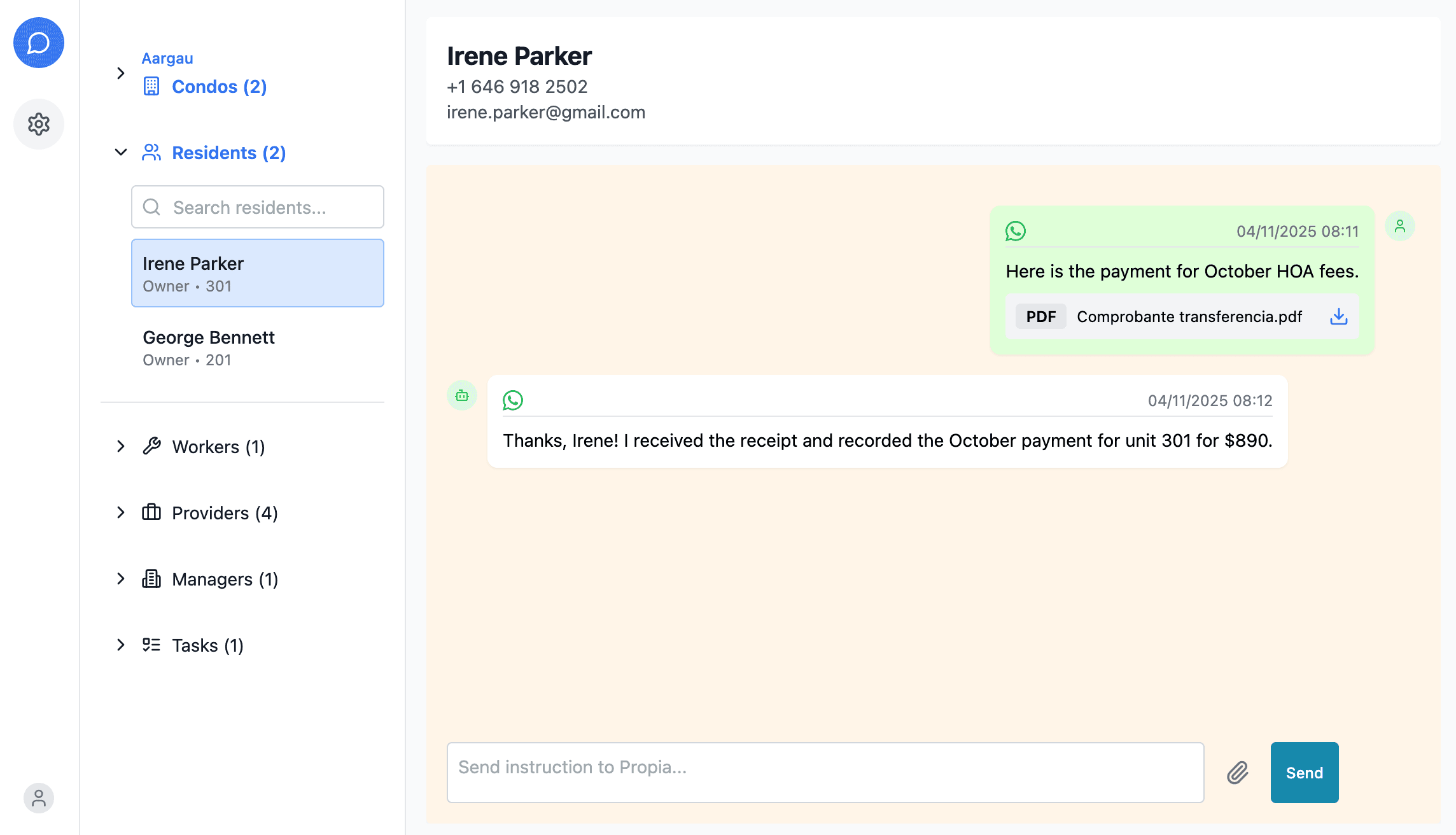
Owners write on WhatsApp, where they already are. Eloria answers from the building's own information — the internal reglamento, common-area hours, current notices — opens a case when a vendor or a junta decision is needed, and escalates it to you. Everything is recorded per unit and per case, so the history survives a change of administrator.
It speaks Peru's vocabulary — cuota de mantenimiento, propietarios, junta de propietarios, áreas comunes — not a translation of Argentina or Mexico's vocabulary.
Managing buildings in Peru and want to see it running on a real building? Message us on WhatsApp and we will set it up with your data.
Message us on WhatsAppKeep reading
- Condo Management in Argentina Guide
Complete guide to Argentine consorcio management: asamblea, administrador and consejo de propietarios roles, expensas billing, and arrears collection under current law.
- Property management in Colombia
How a Colombian conjunto or edificio is run under Ley 675 de 2001: why the property itself is a legal entity, what the asamblea, the consejo de administración and the administrador each do, how the cuota de administración is billed, and how arrears are collected.
- Guide to Building Management in Chile
Everything about building management in Chile under Ley 21.442: gastos comunes, assemblies, national administrator registry, and how to organize communication with owners.
- Guide to Condo Management in Mexico
Learn how to manage condominios in Mexico: legal structure, cuotas de mantenimiento, asambleas, and how to keep records of everything happening in your building. Updated 2026.
- Property management software: what to look for before you choose
A practical guide for condo and building managers: what property management software actually solves, what to ask in the demo, and why resident communication is usually the piece left out.
- The building's WhatsApp group: why it gets out of hand and what to do
Why the building WhatsApp group becomes ungovernable, what the usual alternatives are and why they fail, and how to bring order to resident communication without taking away the channel they already use.
- Expensas, gastos comunes, cuota de administración: one fee, many names
What the monthly owners' fee is called in each Latin American market — expensas, gastos comunes, cuota de administración, cuota de mantenimiento — and what differs beyond the name.